Best Home EMP Protection: Shield Your House From EMP, CME, and Lightning
Protecting a home from electromagnetic threats like EMP, CME, solar flares, and lightning requires reliable, field-tested equipment. This guide highlights five top products designed to defend household electronics, power systems, and networks. Each section explains how the device works, what it protects, and key considerations for installation and maintenance.
Summary of Selected Products
| Product | Brand | Main Protection | Typical Use |
|---|---|---|---|
| EMP Shield – Home SP-120-240-RL/Concealed | EMP Shield | EMP, CME, lightning, surge | Whole home protection at the breaker box |
| Whole House EMP Surge Protector | Bad Wolf | 260kA surge protection for EMP, CME, solar flare | Whole-home surge defense |
| EMP Shield Whole Home Generator Shielding | EMP Shield | EMP protection for residential generators and circuits | Backup power and generator safety |
| High Saturation Ferrite Home EMP Protection | Faraday Defense | Surge and EMP protection for breaker panels | Panelling and main feed protection |
| Haoguo Generator Electromagnetic Protector | Haoguo | High-voltage surge protection for generators/inverters | Protecting home backup power sources |
EMP Shield – Home SP-120-240-RL/Concealed Model

Features include comprehensive protection against EMP, CME, lightning, and over-voltage events, with an insurance-backed warranty offering up to $25,000 for damaged electronics. The device is designed to withstand up to 228,000 amps per phase, emphasizing rugged performance for residential installations.
Whole House EMP Surge Protector

This device delivers over 260,000 Amps of surge protection, built with commercial-grade components and MIL-STD tested for reliability. Its advanced multistage circuitry protects each line, offering faster response times and a compact design for easier installation.
EMP Shield Whole Home Generator EMP Shielding
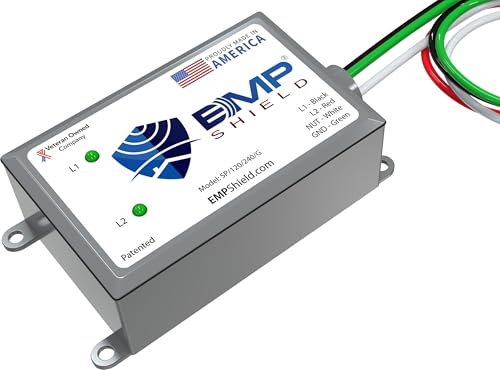
Designed for residential use, this shield focuses on protecting a home’s generator and related electrical infrastructure from EMP and surge events. It emphasizes military-certified protection and U.S.-made quality, aligning with safety standards for critical backup power systems.
Faraday Defense High Saturation Ferrite

These ferrite components are designed to clamp around incoming power wires in a breaker panel, offering high-frequency protection against high-current surges. The ferrite’s dimensions are specified for precise compatibility with typical home electrical setups, providing a straightforward installation path for enhanced protection.
Faraday Fabric 43” x 118”

This 43” x 118” shielding fabric provides broad RF signal blocking capabilities, including WiFi, GPS, Bluetooth, RFID, and NFC. Made from copper, nickel, and polyester, it serves as a flexible barrier for rooms, tents, or enclosures needing discreet EMP and signal shielding.
EMP Shield Ethernet Protection

Specialized protection for networking gear, including laptops, WiFi routers, modems, and desktop computers. The product’s warranty explicitly covers EMP, CME, and lightning, with CAT5/CAT6 RJ45 protection to minimize data damage risks during high-energy events.
Buying Guide: Key Considerations for Home EMP Protection
- Scope of protection: Match devices to your needs—whole-home surge protection vs. generator-specific shielding. Consider whether you want protection at the main service panel, around backup power sources, or for critical IT gear.
- Protection rating and standards: Look for high surge ratings (kA levels) and independent testing or certification (MIL-STD, DHS-listed, or military-grade claims) to verify performance under stress.
- Coverage for multiple risks: A comprehensive system should address EMP, CME, lightning, and fast transients. Some products also insure against electronics damage, which can simplify claims after an incident.
- Installation and compatibility: Ensure the device fits your panel size, generator type, and electrical configuration. Ferrite cores and shield fabrics may require professional installation for best results.
- Maintenance and indicators: Features like status lights or fail-safes help you monitor protection health. Plan for periodic checks and replacements if indicators show degradation.
- Backup power integration: For homes with generators, consider how protection interacts with generator start-up, fuel systems, and inverters to avoid inadvertent faults.
- Budget and insurance: Weigh initial costs against long-term protection, warranty terms, and insurance coverage that reimburses damages. A strong warranty can offset higher upfront costs.
- Practical deployment: For interior shielding fabrics and panel ferrites, plan placements to maximize protection without impacting accessibility and usability of everyday electrical devices.
- Redundancy vs. practicality: While layering multiple devices can improve resilience, ensure not to create conflicting or redundant protection that complicates troubleshooting.
- Reliability in real-world conditions: Look for devices designed for continuous operation in residences, with minimal maintenance and robust environmental tolerances.