Best Most Efficient Tankless Water Heaters for Quick, on-Demand Hot Water
Choosing the most efficient tankless water heater involves weighing fuel type, flow rate, installation flexibility, and energy-saving features. This guide highlights five compact, high-efficiency models suitable for American homes, with options that run on natural gas, propane, or electricity. Each product prioritizes on-demand hot water, space efficiency, and modern controls to help you reduce energy use while maintaining comfort. Use the summary table to compare core specs at a glance, then read detailed sections for each model to understand their strengths and setup considerations.
| Product | Fuel | Max GPM | Key Strength |
|---|---|---|---|
| Rinnai RX199iN | Natural Gas / Propane | 11.1 | Versa Vent, Smart Sense control, WiFi-ready |
| ThermoMate 3500W | Electric | 0.4 – 0.66 | Self-modulating power, compact under-sink design |
| Antuony 3KW | Electric | ~1.5–2.0 (depending on inlet) | Smart digital display, precise temp control |
| Rheem RTG-70XLN3 | Natural Gas | 7.0 | Outdoor install, high efficiency for moderate demand |
| Rinnai RE199eP | Propane | 7.6 | Compact outdoor model, durable design |
Rinnai RX199iN Condensing Tankless Water Heater

This model supports indoor or outdoor installation with Versa Vent and accepts propane or natural gas via a Smart Sense gas control system. It delivers up to 11.1 GPM (suitable for about seven fixtures simultaneously) and features a compact footprint. Its design emphasizes energy efficiency with a high UEF rating and an interface that supports optional WiFi control through the ControlR module. The RX199iN is aimed at households seeking flexibility, robust hot water delivery, and modern diagnostics, though outdoor installations require an appropriate vent cap (RX-OVC).
ThermoMate 3500W Electric Tankless Water Heater

Designed for under-sink or point-of-use installation, this 3500W electric unit provides on-demand hot water with a temperature range of 86°F to 131°F. It requires hard-wiring (no plug) and uses self-modulating power to match input flow with desired warmth, helping reduce energy waste. The unit employs SUS 304 stainless steel water tubes and a cast aluminum heating element for resistance to mineral buildup, making it a practical choice where electrical capacity is available but space is at a premium.
Antuony 3KW Electric Tankless Water Heater

This compact 3KW unit furnishes hot water on demand with a smart digital display that allows temperature adjustments in 1°F increments. It is designed for 110V electrical systems with a self-modulating power feature that maintains the set temperature by adjusting output automatically. Its small footprint makes it suitable for tight spaces in kitchens or bathrooms, and it uses a high-grade copper heat exchanger to support long-term reliability and resistance to mineral buildup.
Rheem RTG-70XLN3 Outdoor Tankless
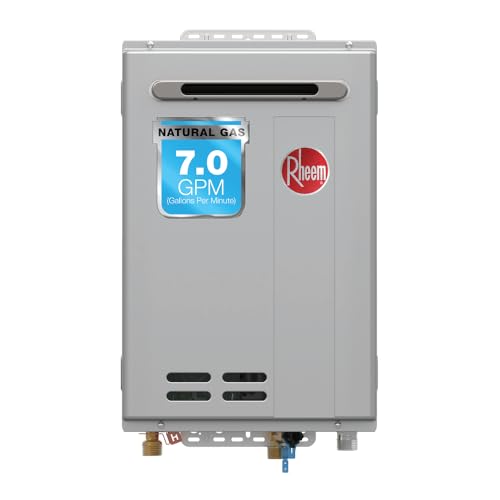
This outdoor, non-condensing unit delivers up to 7.0 GPM with a 160,000 BTU input, providing fast hot water for households with moderate demand. Its outdoor-focused design includes a rugged cabinet and simple wall mounting by a qualified installer. The model is positioned for reliability and straightforward service, making it a strong option for homes that can accommodate outdoor installation and require robust performance without condensing technology.
Rinnai RE199eP Non-Condensing Propane Tankless

This outdoor propane tankless model offers up to 7.6 GPM and is designed for rugged outdoor use with a compact footprint. It features a durable layout and hard-wearing components, and it can be paired with a ControlR module for optional WiFi control (not included). It is an economical outdoor option that prioritizes consistent delivery and compact installation space while relying on propane for flexible fuel access outside of natural gas lines.
Buying Guide: Key Purchase Considerations
Fuel type and availability are primary factors. Gas-powered units (natural gas or propane) typically offer higher flow rates, suitable for larger households, while electric models excel in smaller homes or apartment settings where gas lines aren’t feasible. Evaluate your home’s existing utility connections and venting requirements—compact designs can still need proper venting for indoor gas models. Flow rate needs vary with climate, fixture number, and desired temperature rise, so estimate your peak load to avoid undersizing.
Energy efficiency is crucial for long-term savings. Look for units with high energy factors (UEF) or condensing technology, which recovers heat from exhaust. In addition, consider features such as self-modulating controls, WiFi connectivity, and diagnostic interfaces that simplify maintenance and monitoring. Environmental conditions matter too; outdoor installations require weatherproof enclosures and appropriate clearances.
Space and installation constraints influence choice. Point-of-use electric models are excellent for kitchens or bathrooms where heating demand is localized, while whole-home systems are better for households with multiple simultaneous hot-water needs. Professional installation is recommended for gas appliances, especially those with venting and gas line requirements.
Durability and warranties are worth comparing. Outdoor gas units typically include weatherproof housings and long-term warranties on heat exchangers, but terms vary. Internal components, such as heating elements and seals, should be rated for resistance to mineral buildup when you have hard water. Always check manufacturer instructions for flushing and maintenance intervals to sustain efficiency over time.
To optimize performance, plan for preventive maintenance. Regular descaling, flushing, and inspection of venting (for gas models) can preserve efficiency and extend service life. If you want smart control, confirm compatibility with home automation systems and whether an optional control module is included or sold separately.