Best Portland Cement Based Floor Levelers for Durable, Even Surfaces
When preparing a floor for tile, vinyl, carpet, or hardwood, a Portland cement based leveler can deliver a smooth, stable base. This article highlights top products that help fill, smooth, and level subfloors before final flooring goes down. From lightweight patch compounds to self-leveling underlayments, each option offers unique cure times, flow characteristics, and bonding capabilities. Read on to compare features, uses, and practical considerations to pick the right product for your project.
| Product | Brand | Primary Use |
|---|---|---|
| DAP Flexible Floor Patch and Leveler, Light Gray, 32 Oz | DAP | Crack-resistant leveling and patching prior to floor installation |
| Ardex Liquid BackerBoard, Portland Cement-Based Self-Leveling Underlayment | Ardex | Self-leveling underlayment over subfloors including in-floor heating |
| DAP 20369 Concrete Floor Leveler, 5 Pound | DAP | Concrete floor leveling for basic subfloor prep |
| DAP Bonding Liquid & Floor Leveler Additive, White, 16 Oz | DAP | Bonding agent and additive to improve adhesion and leveling |
| White Portland Cement 5 Pound Bag | Grout 360 | White Portland cement for molds, colored concrete, and grout mixes |
DAP Flexible Floor Patch And Leveler

DAP Flexible Floor Patch and Leveler is a latex-based filler designed to fill and level surfaces before installing carpeting, vinyl tiles, or floor sheeting. It resists cracking and sands to a feathered edge, making it suitable for minor irregularities and small patches. The product sets within approximately six hours, enabling a timely progression to final flooring. This option is particularly practical for DIY projects where quick redraw or touch-up work is needed after subfloor prep. It blends well with several flooring systems and provides a flexible, sandable finish that reduces visible imperfections.
Ardex Liquid BackerBoard Portland Cement-Based Underlayment

Ardex Liquid BackerBoard is a Portland cement-based self-leveling underlayment designed for encapsulating in-floor heating systems and smoothing subfloors prior to tile, stone, or wood flooring. It offers a long working time and can be troweled for extra surface healing, which helps create a uniform finish. The product can be applied up to 1/2 inch thick, making it versatile for moderate unevenness and over membranes. Its ability to correct imperfections quickly—within minutes after pouring—supports efficient installation workflows, especially in larger areas where consistent levelness matters for expansion joints and edge gaps.
DAP Concrete Floor Leveler, 5 Pound

DAP 20369 Concrete Floor Leveler supplies a straightforward option for leveling concrete floors before final flooring installation. It emphasizes compatibility with surrounding building materials and ladders and is manufactured domestically. While primarily marketed for concrete surface leveling, it serves as a practical choice for projects requiring quick patch-and-level capabilities on common subfloors. It’s suitable for general concrete leveling tasks where a reliable, basic leveling material is needed without specialized additives or extended cure times.
DAP Bonding Liquid & Floor Leveler Additive
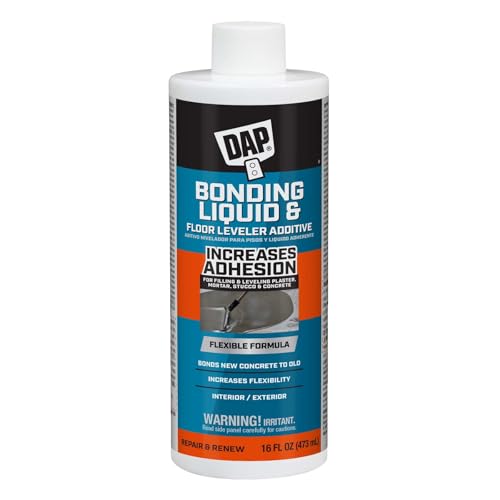
The DAP Bonding Liquid & Floor Leveler Additive acts as a bonding agent that improves adhesion and flexibility for floor leveling projects. With an acrylic latex formula, the additive can help bond new concrete to old substrates and creates a more durable surface when combined with leveling compounds. The liquid is compatible with a range of repair and reconstruction tasks, supporting stronger subfloor prep before applying top flooring materials. It cleans up with soap and water, adding convenience to the workflow and reducing residual residue on tools and skin.
White Portland Cement 5 Pound Bag

White Portland cement from Grout 360 serves multiple roles beyond leveling, including mold casting and colored concrete projects. Its Type 1 designation makes it suitable for concrete and mortar mixes where white color and brightness are desired. For floor leveler applications, this cement can be combined with aggregates, pigments, or bonding agents to achieve custom finishes and improved bond strength in decorative or mixed-material installations. It is a versatile option for projects that blend cosmetic goals with structural compatibility, especially when a white base is preferred for subsequent flooring aesthetics.
Buying Guide: Portland Cement Based Floor Levelers
Key considerations help determine the best option for a given project. Start by assessing the substrate: concrete slabs, plywood over joists, or in-floor heating systems each demand different products and thicknesses. Working time matters for larger areas; some formulas stay workable long enough to spread evenly, while others cure quickly and are better suited for small patches or quick repairs. Thickness requirements will guide whether a self-leveling underlayment is needed or if a patch and skim coat will suffice.
Bonding and adhesion are critical for long-term performance. Additives or primers can improve attachment to old concrete or membranes, reducing delamination risks. For heated floors, self-leveling products designed for in-floor heating systems help prevent cracking from substrate movement and temperature changes. When finishing, ensure the top surface is properly cured and dried before installing final flooring to avoid bond failure or warping.
Cost, availability, and ease of use also influence selection. Some products come as dry mixes requiring water or liquid additives, while others are ready-to-use patches. DIY projects may favor patch-and-go solutions, while professional installations often benefit from self-levelers that produce a smoother, flatter base with less manual labor. Compatibility with final flooring materials—tile, wood, vinyl, or carpet—should be verified to ensure the product supports the chosen finish without impacting warranty considerations.
For project planning, consider whether an in-floor heating system exists, as this affects underlayment choice and thickness. If future repairs or remodeling are anticipated, choose products with easy sandability, good edge feathering, and a reliable cure profile. Finally, verify surface cleanliness, moisture levels, and substrate anchors to maximize leveling performance and minimize call-back issues after installation.